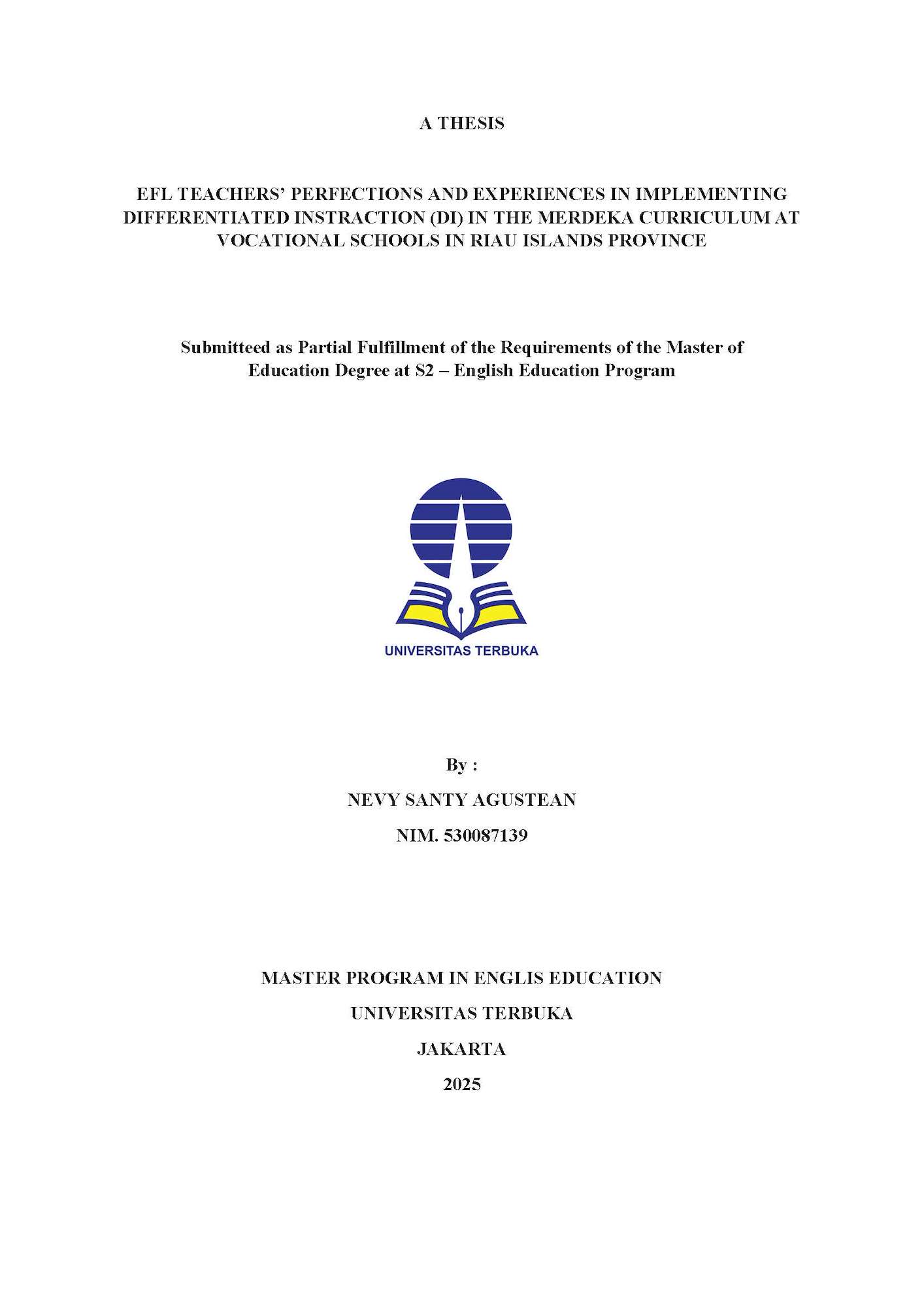
Agustean, Nevi Santy (2025) EFL Teachers’ Perceptions and Experiences in Implementing Differentiated Instruction (DI) in the Merdeka Curriculum at Vocational Schools in Riau Islands Province. Masters thesis, Universitas Terbuka.
content (44).jpg
Download (113kB) | Preview
Abstract
The study addresses the challenges of implementing Differentiated Instruction (DI) in Yocational schools in Indonesia, particularly in the Riau Islands. It aims to explore English teachers" perceptions and practices of DI in the context of the Merdeka Curriculum. The objective is to examine how teachers adapt DI to students" diYerse needs and the impact of DI training, especially among the few Guru Penggerak-certifi.ed educators. This study utilizes a qualitatiYe research design with a case study approach to explore how Yocational school English teachers in the Riau Islands ProYince implement Differentiated Instruction (DI).
Y
Data were collected through questionnaires, semi-st:Iuctured inter iews, and classroom obsen·ations. PurposiYe sampling was used to select three teachers from different schools, focusing on their perceptions and practices related to DI within the Merdeka Curriculum framework. For Research Question 1, Teacher T2 consistently scored the highest in all areas, especially in integrating student interests and adapting instructional practices. Teachers T 1 and T3 demonstrated effectiYeness but require more variety in methods and differentiation strategies. For Research Question 2, all teachers showed com1nitment to differentiated instruction, adapting teaching methods and assessments to support diYerse student needs, though challenges like resource limitations and engagement remain. The study concludes that while Differentiated lnstn1ction (DI) is being implemented effectively by English teachers within the Merdeka Curriculum, there are Yariations in its application. Teacher training is crucial in enhancing DI practices, but challenges remain in material access, school culture, and alignment with moden1 trends. Recommendations include expanding DI-focused professional deYelopment, impro,·ing resource aYailability, and fostering a more supportiYe school culture for DI integration
Actions (login required)

- View Item